- Veneer is a construction method, not automatically a sign of low quality.
- Solid wood moves with humidity and needs construction that allows movement.
- Ask what is underneath the visible surface and how edges are finished.
Read the component, not the headline
Furniture can combine several materials for different jobs. Ask for a component-level specification instead of reducing the whole piece to solid or veneer.
| Component | Questions to ask | What to inspect |
|---|---|---|
| Large top or door | Solid board, veneered panel, laminate, or mixed construction? | Flatness, grain sequence, underside, and movement allowance |
| Edge | Solid lipping, matching veneer, or printed edge band? | Corner durability, seam quality, and repairability |
| Leg or rail | Solid wood, laminated stock, metal, or composite? | Joinery, grain direction, dents, and fastener access |
| Panel core | Plywood, MDF, particleboard, or another core? | Weight, screw locations, moisture warnings, and warranty exclusions |
| Finish | Oil, lacquer, paint, stain, or factory film? | Care instructions, sheen consistency, and local-repair guidance |
The material labels are incomplete
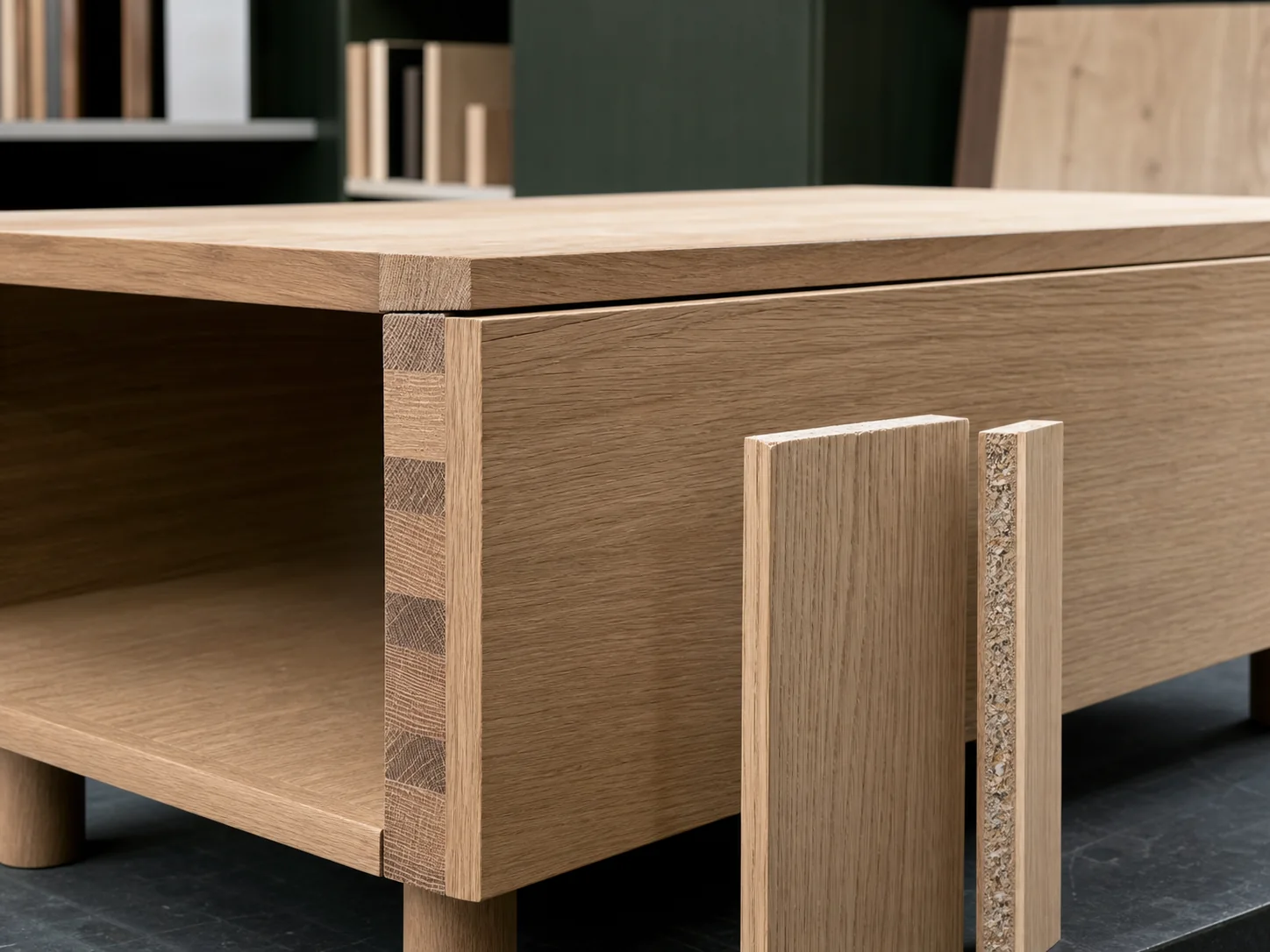
Solid wood means the named component is made from wood through its thickness, although different species may be used in hidden areas. Veneer is a thin layer of real wood bonded to a stable core. That core might be plywood, medium-density fiberboard, particleboard, or another engineered panel, and its quality has a large effect on the finished piece.
A well-made veneered cabinet can be more dimensionally stable than a wide solid-wood panel. A poorly made solid-wood piece can split, warp, or use weak joinery. The useful question is not which label wins, but whether the construction suits the object and its environment.
Where solid wood is useful
Solid wood is valuable at edges, legs, rails, handles, and other areas that receive impact or may need reshaping. Many scratches and dents can be repaired, although the finish determines how simple that work will be. Oil, lacquer, stain, and paint each respond differently to local repair.
Because wood expands and contracts across the grain as humidity changes, wide panels need joinery that permits movement. Look for thoughtful details such as floating panels, elongated screw holes, or buttons beneath a tabletop. A rigidly fixed wide top can crack even when the material itself is good.
Where veneer makes sense
Veneer allows large, visually consistent surfaces without the movement of a wide solid board. Designers can sequence adjacent leaves to create balanced grain patterns and use scarce decorative species efficiently. On doors and cabinet sides, a stable veneered panel may stay flatter than solid wood.
The vulnerable areas are usually edges, corners, moisture exposure, and deep damage that passes through the surface layer. Ask whether edges are solid lipping, matching veneer, or a printed band. Also ask what core is used and whether both faces are balanced to reduce warping.
Questions to ask before buying
Request a material breakdown by component rather than accepting a single headline. A table might have a veneered top, solid edge, solid legs, and engineered internal structure. That combination can be entirely appropriate when it is described accurately.
Check care instructions, warranty exclusions, and the recommended indoor humidity range. Examine the underside and back where construction is easier to see. Precise edges, aligned grain, stable joints, and a finish that continues into less visible areas often reveal more than the solid-versus-veneer label.
- What is the core beneath the veneer?
- Which components are solid wood?
- How are exposed edges constructed?
- Can the finish be repaired locally?
Reading a mixed-material dining table
A table can use veneer honestly and still put solid wood where impact and joinery matter.
- Top
- Oak veneer on plywood core
- Edge
- Solid oak lipping
- Legs and rails
- Solid oak
- Finish
- Factory-applied lacquer
- The veneered plywood top provides a broad, visually consistent surface and should be evaluated for flatness and edge treatment.
- Solid lipping protects the perimeter from ordinary impact and gives the visible edge a repairable wood surface.
- Solid legs and rails place durable stock around joints and fasteners.
- The care decision depends on the lacquer instructions; sanding through the veneer would permanently damage the top.
The construction is not accurately described by either "all solid" or "cheap veneer." The useful purchase questions concern core quality, veneer thickness, edge construction, joinery, finish repair, and warranty.
References reviewed
These resources informed the measurement conventions or technical claims in this guide. RoomFact independently organized the checks, examples, and cautions above.
What readers usually need to verify next
Is veneer fake wood?
Wood veneer is a thin layer of real wood applied to a core. Printed films and paper wraps are different materials. Ask the seller to identify the face material, core, edge, and finish separately.
Is solid wood always more durable?
No. Durability depends on species, thickness, joinery, design, finish, moisture exposure, and maintenance. A poorly designed solid panel can move or split, while a well-made veneered panel can remain flat and perform well.
Can veneered furniture be repaired?
Minor finish damage may be repairable, but deep sanding or a gouge through the face layer can expose the core. Ask for the veneer and finish specification before attempting a repair.
RoomFact uses AI-assisted research, writing, and software development to prepare its guides and calculations. Allen Gomes is the publisher. The linked sources and worked arithmetic let readers check the reasoning. This guide does not claim hands-on product testing or replace a retailer's delivery assessment, trade advice, accessibility review, or local safety requirements.
Read our editorial standards